My father, Les, turns 80 in August.
He was one of eight siblings, born into a family where his dad had fought in WWII and his grandparents rode a horse into town when they needed something. He grew up in Inverell, finished school at fifteen, and moved to Sydney to work. He married, had a daughter, and yearned to get back to the country. The family travelled for a while in a caravan — wife, daughter, the road. Then two boys arrived, they settled in Cowra, and he managed a vineyard for decades.
He plays golf. He gardens. He loves animals. He has sayings — the kind of phrases you start noticing are distinctively his only after they’re already part of your own vocabulary. He’s thoughtful, quietly creative, and an excellent conversationalist. But he won’t write memoirs. Ask him and he’d laugh.
There’s a lot of him that only exists in his head. At eighty, that starts to feel like a problem worth doing something about.
The Wrong Tools
The obvious thing would be to give him a Storyworth subscription or a prompted memoir journal. I’ve seen both in use — my mother-in-law got one, my mum got the other. Both stalled. I wrote about why those products fail — short version: they delegate the whole book to one person, in isolation, and stories don’t want to be written that way.
So I needed something that worked with the grain of how Dad actually is, not against it.
The Voice-to-Blog Idea, Extended
Last year I built a voice-to-blog pipeline for my mate Aaron. He’s a personal trainer — brilliant in conversation, hates computers. The pipeline let him ramble into Telegram on the drive home and have a draft blog post waiting by the time he parked.
The thing that stuck with me wasn’t the plumbing. It was how much of the friction had been about input. Get the input shape right for the person and they have plenty to say.
Dad isn’t going to write for a journal. But he’d happily talk. My sister Michelle would happily talk — she’s the family’s story-keeper, full of anecdotes the rest of us have half-forgotten. My mum would chip in if I asked. My brother would pull photos from the old albums.
Four people, each contributing a bit, each in the form that suits them. Suddenly it’s not a homework assignment. It’s a group project — and the kind where everyone wants to be in the group.
Collaboration as the Gift
The third thing in my head at the time: every Father’s Day, Alice puts together a video montage of the previous year’s family photos and video clips. Hundreds of them. It takes her hours. It is my favourite gift I get every year.
What makes it work isn’t the technology — it’s that she does the work, and I receive it. The gift is her attention, not a task I’ve been set.
I wanted Dad’s book to work the same way. The gift would be the orchestration — the inviting, the follow-ups, the assembly. Dad’s job is just to talk when he feels like talking. Everyone else chips in what they have. The thing that ends up in his hands at eighty is a book, but what he’ll actually feel is his family showing up.
The Book of Les
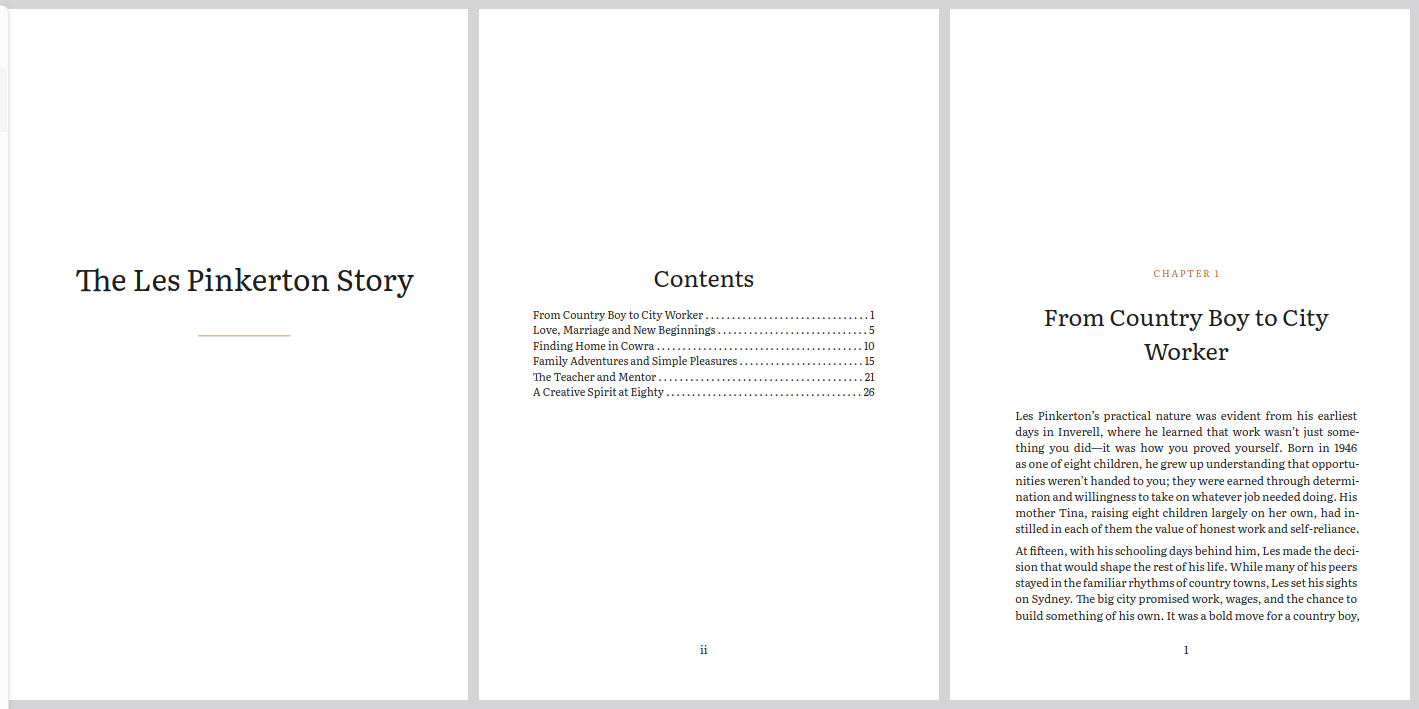
Dad’s book has been underway for a couple of weeks. Voice notes, photos with captions, typed memories. Four contributors. I re-read the whole thing every time new material comes in, because it keeps getting richer.
I called the product Kinbook. It wasn’t designed as a “family history” tool, exactly — it’s designed to let a group capture moments together, in whatever shape suits each person, and end up with something beautiful they can hold.
The Surprise
I told my mate Thomas about Kinbook at a barbecue while the kids played. He signed up that afternoon.
What surprised me was what he used it for. Not a biography of his parents, not a memoir — he started a book for his young son, documenting a year of his childhood. A few weeks later he invited me as a co-editor on a third book, a tongue-in-cheek biography of a mutual friend known for his big personality and forthright opinions. Excerpts have been getting rave reviews in the WhatsApp group.
That pulled Kinbook out of the “tool for getting your elderly dad’s stories before it’s too late” box I had it in. Plenty of people want to capture a year with a young child. A season on a sports team. A first year of marriage. A big trip. Any shared experience with a group around it.
I’ve stopped prescribing use cases. The product is a clean surface — you bring the reason, you bring the people, it handles the rest.
Where This Goes
Dad’s book will be done for his 80th in August. Whether he reads it cover-to-cover or just picks it up now and then, it’ll exist, and my sons will have it when they’re old enough to care.
I’m starting one about my own kids when school goes back next week. Alice and I as co-editors. The funny things they say, the friendships they’re forming, the small moments that slip past otherwise. I don’t think it’ll replace Alice’s Father’s Day montages. It might end up something I cherish just as much.
If you’re circling a book like this for someone in your life — a parent, a child, a friend — Kinbook is live. Start with inviting one other person.