My mother-in-law Mary got a Storyworth subscription from her kids a couple of years ago. The idea is simple: once a week, you get a prompt in your inbox. What was your first job? Tell us about your parents. What were summers like growing up? You write a response. At the end of the year, Storyworth prints the answers as a hardcover book.
Mary worked at it diligently for a while. Then she stalled. Byron, my father-in-law, made it through something like one entry.
The same Mother’s Day, my sister Michelle gifted my mother Jan a physical journal — same genre, paper edition. Prompts inside, ready to fill in. It was a thoughtful gift. Mum got through one page, with me helping in person. The journal hasn’t been touched since.
I’ve now watched four people receive these kinds of gifts. None have produced a book. I don’t think any of them will.
It’s Not the Prompts
The common wisdom is that people stall on memoir projects because they don’t know what to write about. So you get prompts. Fifty-two of them, one a week. Each one calibrated to unlock a memory or a theme.
The prompts aren’t the problem. The structure is.
These products all delegate the entire book to one person, and that person becomes more isolated the further in they get. You sit at the table alone. You write. Nobody sees the draft. Nobody says I didn’t know that. Nobody asks a follow-up. There’s no social loop — no feedback telling you it matters to anyone. You’re just producing. For a book that, by the way, won’t exist for a year.
Compare that to the way stories actually come out in families. Over dinner. In the car. At a wedding. Someone says something, someone else says oh I’d forgotten about that! and a whole other memory unfolds. Stories are social. They want an audience. They want the person across the table to say wait, what? and press for more.
A memoir journal takes a fundamentally social activity and turns it into solo homework. It’s not surprising the project flags.
The Homework Problem
There’s a second thing going on.
When you’re gifted a Storyworth subscription or a prompted journal, the subtext is clear: we want you to produce something for us. That’s a loving gesture, but it’s also a workload. You, specifically, are on the hook to write a book.
The people doing this are often in their 70s or 80s. They have competing demands on their energy. They don’t want to let their kids down. So the journal sits on the nightstand accumulating guilt. The Storyworth email goes unread, and then there’s last week’s unread too, and now you can’t face opening either one without thinking about the one before.
My father won’t engage with systems like this. He told me so. My mother tried and couldn’t sustain it. This isn’t about them being uninterested in their own stories — Dad will happily talk for an hour if you ask him about growing up in Inverell. It’s about being handed an obligation and no social context to fulfil it in.
What Actually Works
Three things I’ve noticed work, looking around.
One. Every Father’s Day, my wife Alice puts together a video montage of the previous year’s family photos and video clips. Hundreds of them. It takes her hours. It is, no exaggeration, my favourite gift I get every year. What makes it work isn’t the tooling — it’s that she does it, and I receive. The gift is her attention, not an assignment.
Two. My mate Aaron is a personal trainer. Twenty years of hard-won knowledge, and he can’t stand sitting at a computer. I built him a voice-to-blog pipeline last year because the content was there — it just needed to come out in conversation, on the drive home, not at a keyboard. Match the input to how the person actually expresses themselves and they suddenly have a lot to say.
Three. When I asked my sister Michelle to contribute to a book about our dad, she jumped in. She’s the family’s story-keeper — full of anecdotes the rest of us have half-forgotten. She wouldn’t write a memoir alone, but when someone else is working on it too, her appetite to chip in is basically infinite. The social context changes everything.
Combine these: the work is distributed across a group, the input matches how each person talks, and the person who set it up stays active rather than handing off.
The Shape That Works
The right shape for this kind of thing looks more like a group chat than a journal. You’d have:
- An owner who cares enough to set it up and keep it alive
- A handful of contributors who each chip in occasionally
- A way to capture in thirty seconds from a phone — voice, text, or a photo with a caption
- Gentle, specific follow-ups that actually respond to what’s been said, rather than generic prompts drawn from a list
- An artefact at the end worth holding onto
The homework model treats producing the book as the job. The collaborative model makes the conversation the job, and the book falls out of it.
What I Built
I built this for my own dad’s 80th. His birthday’s in August. I’d already accepted he wouldn’t use a Storyworth or a journal, and I didn’t want to waste his energy on something that would stall.
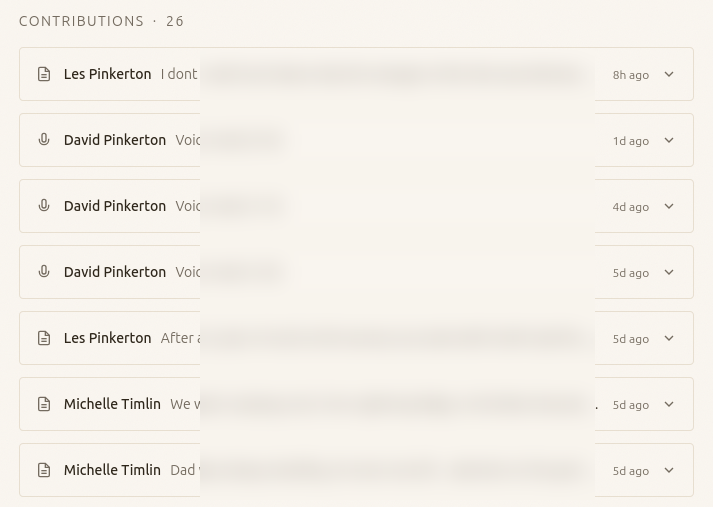
The result is Kinbook. You invite a few people, everyone contributes in whatever form suits them, and it assembles into a book over time. Dad’s book is underway with four contributors already. I re-read the whole thing every time new material is integrated, because it keeps getting richer.
It’s not a replacement for the kind of slow, deliberate memoir you’d sit down and write if that’s your thing. It’s for the other ninety-odd per cent of cases, where the stories are real, the person is willing, and solo homework just isn’t going to produce anything.
The test isn’t whether the prompts are clever. It’s whether your mum still opens the app next Sunday.